Well, hello everyone! This has been a crazy summer of job hunting and decision making. I have found myself back in the classroom teaching sixth and eighth grade math. The first month of school is almost over and things are going well.
My eighth graders are studying exponents and their rules. There have been learning so many rules that students are starting to mix them up. To review the individual rules again, I wanted to have task cards and students moved from station to station. I had a really hard time finding task cards that just focused on one rule at a time. So, I made my own set of task cards.
I thought that I would share them in case anyone else was looking for the same. I will also leave it as a PowerPoint in case any little tweaks need to be made. I made theses for my students and where I think they are. I wasn't thinking generically, so I understand that some tweaking may be involved.
Enjoy!
9-24-15: I make a couple of adjustments to the task cards. I added numbers to keep them all straight and make the title separations into station signs. An answer key will be coming! I just have to finish making it! I will also post my answer sheet for this set of task cards.

Showing posts with label Algebra. Show all posts
Showing posts with label Algebra. Show all posts
Saturday, September 19, 2015

Saturday, September 20, 2014
A Group Test after the Test...Here's How It Went
I tried something that I learned by reading a conversation on Twitter this summer. I would only be guessing at who was having this conversation, so if you read this and it sounds familiar, let me know so I can give you credit. Anyway, the conversation was about tests and retesting.
What I found interesting was the idea of retaking the test as a group the day after they take the test individually. The group has limited time, say 15-20 minutes, to complete the test. I tried this with our first skill quiz in Algebra this year.
My reasons for trying it were to:
1) help students see that they are not the only ones with a question,
2) allow peers to work together and think through the quiz,
3) to give me and opportunity to listen to how students were explaining the math to each other, and
4) to make sure that everyone had a copy of the quiz in their math binders with the problems worked out (some students will never bring back the signed test to put in their binder).
I have two completely different groups. My first group is a higher ability group that doesn't enjoy being quiet and still for more than 10 seconds. This has been a challenging group so far. My other group is quieter, but as a group, they struggle a little more to understand the material. They present a different type of challenge.
I say this because there were two different outcomes for this activity. In my first group, I walked away feeling "meh" about the process. It took a lot of work to get them started and on task, even with regrouping them so that students that did well were placed with students who didn't. They were also more argumentative with each other in a nonproductive way. I struggled to convince them of the value of their work. We will try this again on another quiz/test, but I am thinking to take it another way. I am thinking of making it an error analysis activity and using mistakes that students actually made on the test.
My second group had a totally different experience. They got right to work, helped each other, and talked about the questions. I heard thinks like "I thought you had to..." and "But why wouldn't you..." while they were working with each other. This was completely beneficial for them. I also was able to answer questions that stumped the entire group, which made for a great dialog between the students and I. I felt like this group walked away with understanding of what they did wrong and what still needed more practice. It was a good use of time and we will try it again in the same way.
In sharing this technique, others thought that I should do this before the quiz/test. I don't think that it is a bad idea by any means, however I have two concerns. My first concern is that the only way that they will review for the test, will be the group test. I want them to know how to study for math without me giving them questions. The second concern that I have is that the questions are standards based and more open ended. I am a novice at writing questions this way and am just not confident I can write three or four questions that I really like, so I can do a practice test, test, and re-test. I'm not ruling it out, but I'm just not ready to go there, yet.
What I found interesting was the idea of retaking the test as a group the day after they take the test individually. The group has limited time, say 15-20 minutes, to complete the test. I tried this with our first skill quiz in Algebra this year.
My reasons for trying it were to:
1) help students see that they are not the only ones with a question,
2) allow peers to work together and think through the quiz,
3) to give me and opportunity to listen to how students were explaining the math to each other, and
4) to make sure that everyone had a copy of the quiz in their math binders with the problems worked out (some students will never bring back the signed test to put in their binder).
I have two completely different groups. My first group is a higher ability group that doesn't enjoy being quiet and still for more than 10 seconds. This has been a challenging group so far. My other group is quieter, but as a group, they struggle a little more to understand the material. They present a different type of challenge.
I say this because there were two different outcomes for this activity. In my first group, I walked away feeling "meh" about the process. It took a lot of work to get them started and on task, even with regrouping them so that students that did well were placed with students who didn't. They were also more argumentative with each other in a nonproductive way. I struggled to convince them of the value of their work. We will try this again on another quiz/test, but I am thinking to take it another way. I am thinking of making it an error analysis activity and using mistakes that students actually made on the test.
My second group had a totally different experience. They got right to work, helped each other, and talked about the questions. I heard thinks like "I thought you had to..." and "But why wouldn't you..." while they were working with each other. This was completely beneficial for them. I also was able to answer questions that stumped the entire group, which made for a great dialog between the students and I. I felt like this group walked away with understanding of what they did wrong and what still needed more practice. It was a good use of time and we will try it again in the same way.
In sharing this technique, others thought that I should do this before the quiz/test. I don't think that it is a bad idea by any means, however I have two concerns. My first concern is that the only way that they will review for the test, will be the group test. I want them to know how to study for math without me giving them questions. The second concern that I have is that the questions are standards based and more open ended. I am a novice at writing questions this way and am just not confident I can write three or four questions that I really like, so I can do a practice test, test, and re-test. I'm not ruling it out, but I'm just not ready to go there, yet.
Saturday, August 9, 2014
Tellagami for Vocabulary...I'm Still Unsure

When I first saw it, I thought what a cool idea for getting students to show multiple representations of the same vocabulary word. After closer inspection, I realized that the students were actually showing how to solve the problem. I thought this is brilliant and totally motivating for middle school kiddos.
Since I had never heard of Tellagami, I downloaded the free version from the app store on iTunes to my phone. I played with it a little bit and it is pretty simple and students would figure it out quickly. It's nice from the standpoint that there are a limited number of choices that the students can pick, so they can't spend hours picking the outfits and hairstyles and then never get to the math. There is the option to type in the text and let a computer voice say it or you can record your own voice.
I have finally made my first gami about slope. To start, I made up some cards about slope. I opened the app and selected the background, then took a picture of my cards with the little person on the screen. Then I recorded a little something about slope. It was really that simple.
 |
| To hear it play, click here |
But, there are some downsides to this app that I found as I played:
1) There are in-app purchases (boo!).
2) There is a limited trial time to access everything. After that you are left with one type of clothing which you can change the color of the shirt/pant. That doesn't bother me. Losing the ability to type what the character should say and then pick a voice is a bummer for me. I don't want to pay for it.
3) There is the cost for the educational version of the app. The cost is $4.99/subscription. The up-side is that there are no in-app purchases. It's just a bit too much to ask my school to pay at this time.
4) Because of the in-app purchases, I can't have students use their phones to produce a Tellagami.
5) Students are limited in the free version to 30 seconds. I believe it is reasonable for a vocabulary word, but might not work to explain a problem.
6) There just isn't an easy way to collect them and put them into a file for later that I can figure out. The email depended on the email entered into the device. We can't use Facebook or Twitter for good reason from our school devices. The only other option to share is via text. That is how I was able to link my screen shot to the gami that was made. So, timing is vital if students create these. We need to share them during the same class period. Or, one day is for planning and another day is for recording/sharing.
I know that my students would love it. But I am not sure after playing with it. So I started thinking of alternatives. Since my students enjoy making videos, we could do it without the Tellagami app and just record a video and save it to Google drive. We would loose the computer animated person though and I know that would be novel and intriging. They could make their own figure and insert it into the video. Ultimately, the idea that Matt wrote about on his blog can be adapted.
I am putting this out there, hoping, that maybe there is someone wiser than I, who can tell me other options to work around the downsides of the app. Does anyone use Tellagami (or something similar) in their classroom? What do you do with it? Love to hear about it!
Thursday, July 31, 2014
Frog, Log, and the Questions that Ensue...
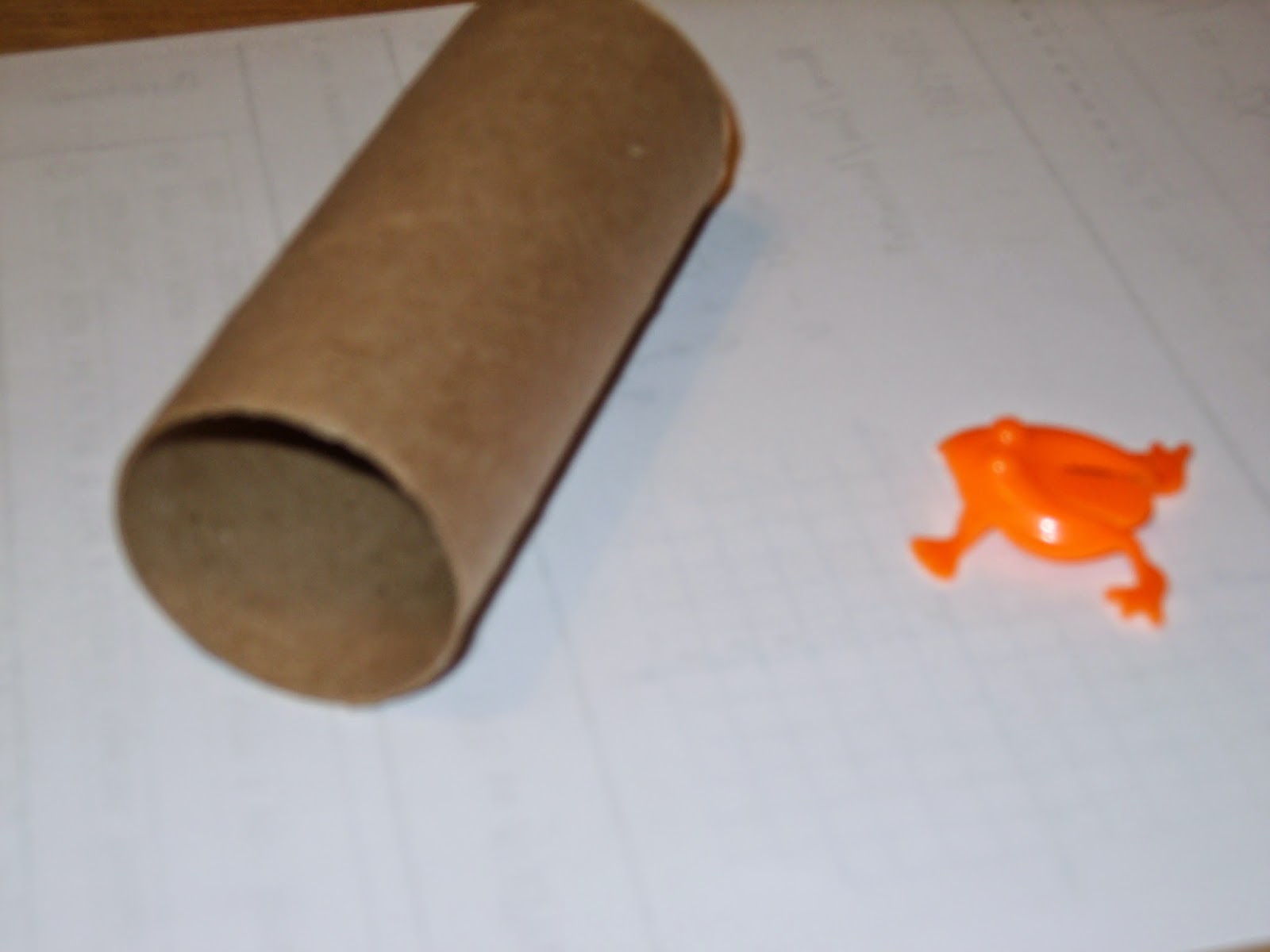
Anyway, I started playing with the flippy frog instead of working diligently. I then started wondering if the frog could make it over the toilet paper tube. I thought it was a solid experiment and worthy of exploring. So, I did.

What I noticed was that sometimes, he didn't make it over the log.

Yet, other times he would make it.
Now, I realize that it doesn't take any great skill to know that this would happen. It fact, a small child probably could have told me what would happen. I started wondering if the frog was more likely to make it over the log (aka toilet paper tube) or not to make it. I hypothesized that it would be an equally likely chance that the frog would make it over the log. Well.. at least theoretically, it should. The operator plays a huge role in changing the chance of the frog making it over the log. My frog failed to make it over the log the majority of the time.
I could use this idea for a demonstration of theoretical v. experimental probability, but I wanted more to the lesson. So that led me to the question, at what distance is it improbable that the frog will make it over the log? At what distance is it almost certain that the frog will make it over the log? What then is everything in between those two distances? Are they all capable of producing the same probability? Where does it change?

I feel like my students could determine a distance where it is improbable that the frog will make it over the log and where it was almost certain. I'm not sure that the data in between those points can be determined as easily without quite a bit of experimentation and data collection. There is nothing wrong with doing that, but I am wondering if it is an activity that will be valuable for the time that it would take. I was playing for over an hour. I know that we could do some group collection of data and analyze that. There would be value in doing noticing and wondering.
I am feeling unsatisfied by the results though, and it bothers me. Maybe because it seems that there should be a simple answer. However, maybe I am looking for a simple answer when their isn't one. There is even the possibility that the experiment doesn't support what I want to know and I need to revise. I'll have to keep thinking. Data and probability won't be until mid-year. Plenty of time to develop, modify, or throw out this idea.
If anyone has any thoughts on any of the questions that I posed, I'd be open to hearing your thoughts. I will be thinking about this some more. If I develop this farther, I will post what I did and anything that I used to guide the students.
Friday, July 18, 2014
Out With The Old...
Well, I finally decided that I am going to remove the problem solving category from my grade book. That isn't as horrifying as it sounds. For many, many years, I have been giving students problems that would stretch them and get them to think a bit more creatively. This was to be done independently of class time. Some years, it has worked brilliantly and other years it hasn't been as successful. I just feel like this has run it's course and is time to try something new.
As my classroom transitions next year to a blended and then flipped classroom, I am realizing that I will need to differentiate much more than I am currently doing. I also need established tasks for independent work time or for fast finishers. What I have done in the past just won't cut it for next year. I have also been reading a lot about standards based grading and I am realizing that I have a great opportunity to replace something that needs to be gone with something that can tell me more about my students understanding.
The one hurdle I kept running into was the book. Saxon isn't totally designed for how my train of thought was going. As I was flipping through the teacher pages, that I've never really read, I found a list of lesson by topic. As I examined the list, I decided to go rogue and not follow Saxon lesson by lesson. I know it isn't recommended, and yes, I may regret this, but it is worth a shot right now. So I am offering my apologies to all of the Saxon Algebra I users who are yelling at me as they read this.
The beauty of freeing myself from following lesson by lesson was that I was able to create. I started looking through an old Transition Math and CPM Foundations of Algebra, Year I textbook that I had and found some inspiration. I put some twists on a few of the ideas to match the standards I was teaching. Once the creative juices were flowing, I was getting more and more excited about what was appearing on the paper before me.
Here is what I created. I am excited to use these in place of the problem solving I have been doing. I am hoping for a richer experience for my students and myself!
As my classroom transitions next year to a blended and then flipped classroom, I am realizing that I will need to differentiate much more than I am currently doing. I also need established tasks for independent work time or for fast finishers. What I have done in the past just won't cut it for next year. I have also been reading a lot about standards based grading and I am realizing that I have a great opportunity to replace something that needs to be gone with something that can tell me more about my students understanding.
The one hurdle I kept running into was the book. Saxon isn't totally designed for how my train of thought was going. As I was flipping through the teacher pages, that I've never really read, I found a list of lesson by topic. As I examined the list, I decided to go rogue and not follow Saxon lesson by lesson. I know it isn't recommended, and yes, I may regret this, but it is worth a shot right now. So I am offering my apologies to all of the Saxon Algebra I users who are yelling at me as they read this.
The beauty of freeing myself from following lesson by lesson was that I was able to create. I started looking through an old Transition Math and CPM Foundations of Algebra, Year I textbook that I had and found some inspiration. I put some twists on a few of the ideas to match the standards I was teaching. Once the creative juices were flowing, I was getting more and more excited about what was appearing on the paper before me.
Here is what I created. I am excited to use these in place of the problem solving I have been doing. I am hoping for a richer experience for my students and myself!
Saturday, July 12, 2014
What's My Function?
 |
| The bottom x value is a 3. It isn't very clear. |
 A few years I switched schools and in that move, lots of stuff ended up in my office area at home while it waited to go to it's new home in my new classroom. Well, some of it never made it and after looking at it for the past 3 summers, I finally decided that it was time to dig through what was in the boxes and start organizing or throwing.
Here is a little gem that I came across in the files. Writing the function rule from a table was a challenge for this particular class, so I had them make these cards. Everyday, a new student posted their function table and the class worked to figure out the rule. We then posted it for students to use for review on their own. It was great practice, but it took a lot of time! I think that is why is is still sitting in the file because it would impossible that I just forgot about it! : )
I started thinking about this because I liked the premise of what I did. So I came up with two alternatives to use instead.
1) Students would find a new partner each day and practice finding the function rule of their partner's card. It would allow the opportunity for the students to practice coaching. Also, it gives them an opportunity to explain their thinking and get clarification from a peer if needed.
2) Students could put the same information onto an index card. They could do a mix 'n' match with them. I could collect the cards and redistribute everyday and do a quick 5 minute review. The index cards could also go into a station activity at a later time.
There are probably more ways to use this that my summer brain isn't coming up with yet. Does anyone else have an idea of how to use this in the classroom?
Wednesday, July 9, 2014
Algebra Zoo
 |
| It's hard to see on the picture, but the fish are Cs. |
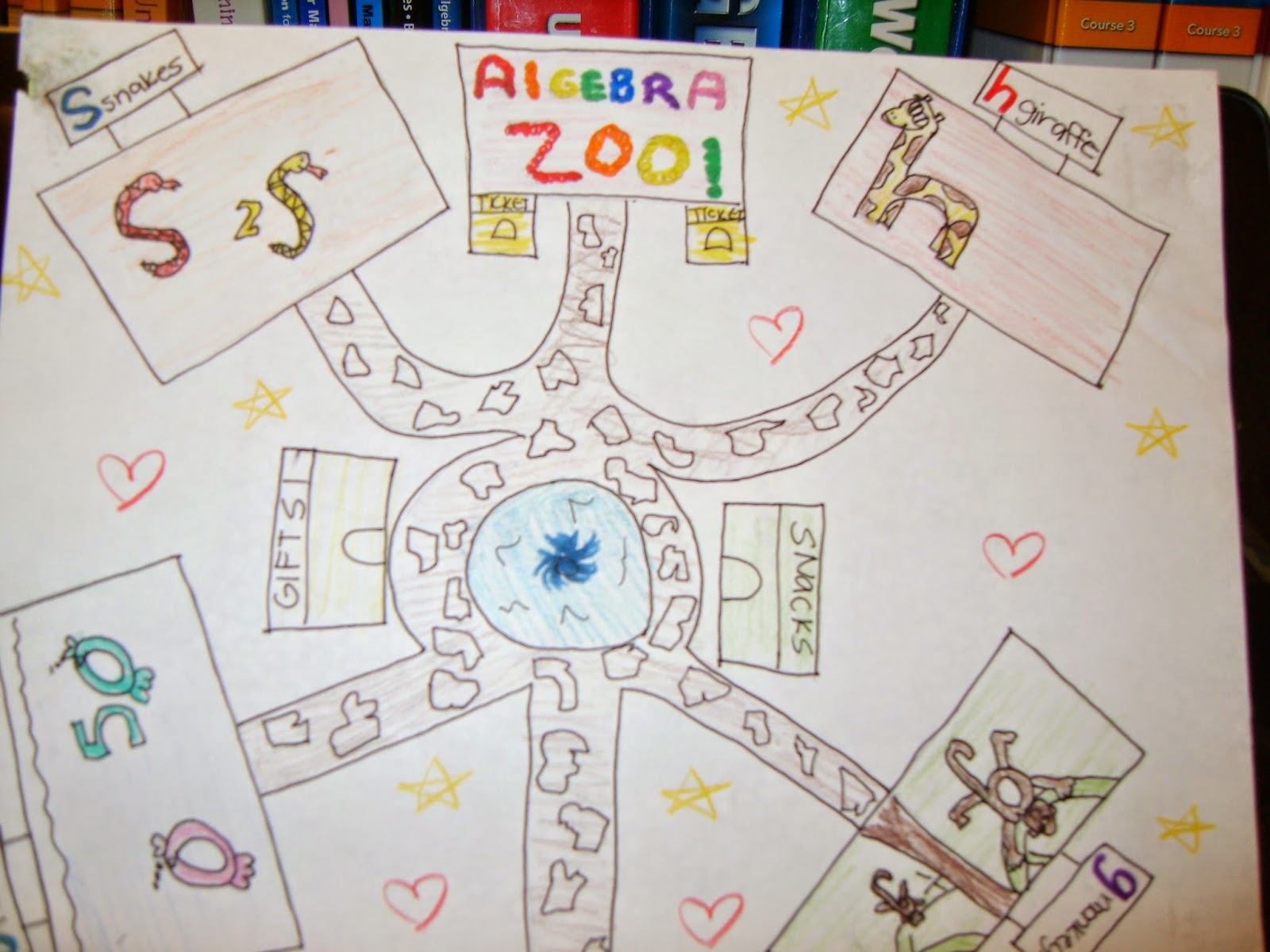
The "Algebra Zoo" goes back to my eighth grade algebra teacher, Mrs. Ryan. Mrs. Ryan was from Ireland and she had red hair, an Irish accent, and told fabulous stories. I really liked her because she had silly stories that helped me remember important ideas in math.
Mrs. Ryan asked us one day, "What is a zoo like?" and we said the normal things like a lion, bear, giraffe, cages, animal shows, etc. She then asked "What animals are put in each cage?" She then went on to ask something like, "Why wouldn't you put the lions and gazelles together?" and the obvious answer was that the lion would kill the gazelle.
 |
| The dolphin forms a U! |
She did stress that x and 5x were the same creature, but they looked different. They were special and lived peacefully in the same cage.
 |
| I love that the monkeys are Gs! |
That idea has stuck with me since 8th grade and I have told that story, or at least some version of it, to many students. I have only been having students make pictures that we display as a reminder for the past few years. It is silly but it really does help some students.
When I give this assignment, I ask the students to be creative. I ask them to try and make their animals look like the variable they represent. I expect that it is colored and neatly finished.

I also tell them that although x and x^2 look the similar, they are not the same creature and cannot be in the same cage together. It is always interesting to see what they can come up with in their pictures.
I will admit that this is cutesy, but sometimes, cutesy just works! :)
Sunday, July 6, 2014
Kahoot! is a Hoot!
Kahoot! can be played on a computer, a laptop, an iPad, or a cell phone. As long as you have access to an internet connection and web browser, you can play from anything. Here is a quick walk through of Kahoot! I took a lot of screen shots so you get a feel for the game part of the site. I was also in the preview mode, not the full game of the literal equations review/quiz that I had made. The cell phone is only on the side when you play a preview of a review/quiz.


Students are then prompted to enter a username. I know when I do this next year, I will assign the group names to the students. This was the most time consuming part. As students enter their username, it appears on the screen. When all of the students are entered, push the start now button and the review/quiz will begin.

The question comes up without choices to give students time to read it before the choices appear.


I usually don't talk about a website to this extent, but this is actually one that I am excited about and think it will be useful next year to switch things up and do something different.
Thursday, July 3, 2014
Mathematical Conversations
 Mathematical conversations are a technique that I learned over a year ago, but never put it into practice. This year I am going to give it a go and I am hoping that it helps some students solidify vocabulary and procedures.
The technique is pretty simple. The teacher writes a script that the students will read in partners or triads. The students then put on their best acting abilities and read the script with each other. The script should be read through at least twice and students should change roles. The script does not have to be long, but should be focusing on key vocabulary, procedures, or concepts that students aren't understanding.
After students are comfortable with the way a mathematical conversation should be in the class, they can try their hand at writing their own for the class to read or acted out by the authors. It is a great way to get writing happening in the math classroom! Student written or teacher written scripts could make a possible activity for a station. Several scripts as stations could be a review activity as well.
My first attempt at trying to write a mathematical conversation is below this paragraph. I picked the topic of subtracting integers because it is reviewed in the text and I know that this was hard for the kiddos last year. As Algebra students,
they have to be comfortable with the subtracting integers. My conversation is longer than what it should be. In reality, it should be less than a page. I just wanted to try and bring in some conceptual understanding too. I am also debating if I should go with the traditional rule of "add the opposite" or stick with the "keep, change, change" rule that I went with last year. For consistency, "keep, change, change" really is the better choice. If the conversation would be useful to you, you are welcome to it.
Saturday, June 28, 2014
Frog Flippin' (Measures of Central Tendency)

Last year, I did an activity I called "Frog Flippin'". I have about 10 of the medium size version of these frogs. I asked the students to flip and measure the frog 10 times, record the data, calculate the mean, median, and mode of their frogs distances. I then asked them to add 30 cm to their longest jump to create an outlier. I found, at least in my experiments, the frogs were pretty consistent jumpers and didn't naturally create an outlier, so I made one exist. The students then examined what happened to the data with the outlier in it and we discussed what happened when it was taken out.
Next year, I want to add more data for analysis, even if it will take some more time. I am still giving this expansion some thought and tweaking but it is pretty well organized. To expand the project, I am going to add in additional sizes to the activity. By posing the question: "Which size frog goes the farthest?", I am hoping to intrigue the students enough that they want to know the answer themselves.
The main idea is that students will collect data for 10 flips for each frog in small groups picked by me. Students will then need to calculate the mean, median, and mode of the data. I want to open a discussion about how to pick the best measure of central tendency so that each size frog is represented most positively. Which measure of central tendency should be used? Will their chose vary by the size of the frog?
After this, I will ask if anyone is wondering anything about their data or the measures of central tendency. I am hoping someone will wonder if more data would change the results. I am also hoping that if there is an outlier, someone will question that as well. Students will then gather data from their peers and recalculate the measures of central tendency. Students are asked to make observations about what they are noticing. Then, we'll examine outliers and the role they play in skewing data.
The original activity and the activity that I have been developing are attached if you are interested!
Original Activity:
3 Sizes Activity:
Friday, June 27, 2014
123 Switch! (Game to Practice Adding/Subtraction Integers)

Tom has a hand made template that students drew in their notebooks. I see the value in that and would prefer that, but I know my kiddos and they need a game board. So I made a template for addition and subtraction. I am going to print them out on some fun colored paper and then glue them back to back. With some quick lamination, they should be ready for the next school year!


The first thing you do is pass out 7 cards to each player. The black cards are positive and the red are negative. The first player puts down a true equation based on the cards in their hand. If they can't, they need to select cards from the draw pile until they can.
The next player can change 1, 2 or 3 cards by placing a card on top of one already on the board with one from their hand. In the picture below, I could replace the 6 of diamonds with the six of hearts. I could replace the 9 of spades with a 7 of clubs. Then replace the 6 of diamonds with a 4 of diamonds and still have a true statement without changing the 3. I could also just replace all three cards. The goal is to be the first person to get rid of all of his/her cards.
The game becomes more challenging when you have to make subtraction equations. I like that the game is challenging and competitive enough to keep the students interest. Not to mention, it's a great way to practice!
Here are my templates for the game boards. I also made a direction sheet for the students.
Thursday, June 26, 2014
Product Race! (Product Rule of Expoents Game)

The game board is a basic square design and the first person to return to the start square is the winner. The students roll a die and move the number of spaces indicated on the die. Then, they pick a card and using the expression on the game board, multiply the two expressions together. If the student is correct and his/her peers agree, then the student may take one extra turn. If incorrect, another student takes their turn.
I recycled some old file folders by putting the game board into them. It fit really well. I then put the directions for playing the game on the front cover and snipped the corner that had the label. The final task will be to laminate the entire folder for durability. I am going to keep the cards separate from the boards in their own snack sized bags. I thought about duct taping them to the back of the folder, but I thought they would stack better without the bag of cards on the back of it.

The game board, directions, and cards are below if anyone would like them. I don't like that the word formatting changed all of the letters to capitals, but until I can figure out how to fix it, it will have to do.
** Update: Much thanks to Kayla who told be how to fix the letters. It was so simple! I should have figured it out. Nonetheless, I appreciate the assistance!
Wednesday, June 25, 2014
Zero!

The game is basically blackjack with the goal being to get 0, not 21. The red cards are negative and the black cards are positive. The student with the number closest to 0 when the cards are added is the winner of the round. Students calculate the absolute value of each of their round totals, then at the end of the game, they add up the absolute value column. The student with the number closest to zero, is the winner of the game. This sounds like a blast! I think my kiddos will love it and it reinforces addition of integers and absolute value all in one game!!
There is a link above to Julie's explanation of the game at "I Speak Math". Her direction and score sheets are there as well. I don't subscribe to Scribd, so I recreated the direction sheet and score sheet myself. It is basically what Julie has, but I added learning goals, supplies, an example on the score sheet, and a reminder to turn it in for credit. It is below if you'd like it.
Thursday, June 19, 2014
Practicing Expressions and Their Vocabulary
 | |||
| Opps! Should have had the "s" in coefficients in parentheses. |
With some thought, I came up with two different ideas. One of them is in the picture at the left. I had these numbers left over from when I was "The Mathematical Wonder" superhero for the day last school year. They got me thinking that I could have the kids make expressions and define the different parts of the expression to a partner. It wasn't a bad idea, but I didn't feel like I was stretching them. Then, brilliance struck and I thought, "what if their expression had to meet specific criteria?". That would challenge them to create an expression and understand the vocabulary words!
I created some simple task cards which you can download below. If the dollar store is out of the numbers, I am going to use the plastic bottle tops that I've collected and my trusty sharpie to make my own set of numbers.
I wanted something else to practice with that was active. So I thought about the Kagan cooperative group technique called "Mix-'n'-Match". I have had good success with this in the past. If you're not familiar, students each have a card and have to go and tell someone the answer to what is on the card (or explain something to another student). So student A explains to student B, then Student B explains to student A what was on their card. The two students then swap cards and go talk to someone new. This goes on for 5 minutes or so. I like it because there is a lot of practice happening in a short time frame and it gets them up and moving.
After I made the cards, I thought that they would work well for an inside-outside circle activity. For this activity, students make two circles with one circle inside of the other. Students face each other so that one student on the outside circle is facing a student from the inside circle. They talk about the cards, swap them, and then either the inside or outside circle moves while the other stands still. There are lots of variations on this activity, so do what works for you. Below are the cards that I made.
Sunday, May 25, 2014
Literal Equations
Last week the kiddos were having a lot of trouble with literal equations and I decided to make some task cards for them. This is my first attempt at making my own task card and my own boarders. I think they turned out nicely for a first attempt. I put QR codes on them because I was trying to save my sanity. Just putting some questions on the board without a check was not a good idea! :)
Since I made the task card, I thought I would post them for anyone who wants them. I got the equations from 2 different worksheets that I downloaded from the internet a while back. I can't find the exact ones again. My apologies to the original authors!
Here it is in Power Point, but it is converted from the Keynote version, so you might need to clean it up a little. Sorry! (The Keynote version is below.)
Here is the Keynote set of task cards:
Hope they help someone out! Enjoy!
Here it is in Power Point, but it is converted from the Keynote version, so you might need to clean it up a little. Sorry! (The Keynote version is below.)
Here is the Keynote set of task cards:
Hope they help someone out! Enjoy!
Sunday, April 13, 2014
QR Codes Rock!!
I recently purchased a task card activity from Teachers Pay Teachers that used QR codes as a way for the students to check their answers. I have always been intrigued by the use of a QR code in the classroom, so I decided to stop wondering and give it a try. Perhaps foolishly, I decided to try it during an observation with my principal. However, my principal enjoyed seeing the technology and discussed other applications for the QR codes within the classroom that would be beneficial for students, teachers, and parents. I appreciated the feedback and brainstorming from him and decided to see how hard it was to make a worksheet with QR codes on it.
Well, it was a cinch and if you haven't tried them, you have to try them! I made the simple worksheet that you can download below this paragraph. I used it for Lesson 82 of the Saxon Algebra I (2007), so all of my fellow Saxon users feel free to take it and use it! Just one caution, the problems are the examples from the book's lesson. I dd that intentionally, so that I could have students who were truly stuck and not sure what they did wrong check their work to the books work if I was busy helping others. I never had to do that though because they helped each other so well.
To make this, I Googled "How to make a QR code" and found several websites that would let you make a QR code. I used the website http://www.qrstuff.com/ to make the codes and then download them for free. Then, I copied and pasted them onto the worksheet. I am a novice to doing this though, so my formatting is simplistic.
The students used their cell phones with a QR reader/scanner to check their answers. I found that the students really liked being able to check the answer as soon as they finished the problem, so with some simple ground rules, I had no problems with cell phones being used for other purposes.
I am really excited about the possibilities that I can do with the QR codes. Next time, I would like to have a "Need help?" section at the top with a QR code attached to a You Tube video or another source for students who are stuck or just need reassurance and I am busy with another student. I am feeling like this could be a really good thing for my students and how I teach.
Well, it was a cinch and if you haven't tried them, you have to try them! I made the simple worksheet that you can download below this paragraph. I used it for Lesson 82 of the Saxon Algebra I (2007), so all of my fellow Saxon users feel free to take it and use it! Just one caution, the problems are the examples from the book's lesson. I dd that intentionally, so that I could have students who were truly stuck and not sure what they did wrong check their work to the books work if I was busy helping others. I never had to do that though because they helped each other so well.
To make this, I Googled "How to make a QR code" and found several websites that would let you make a QR code. I used the website http://www.qrstuff.com/ to make the codes and then download them for free. Then, I copied and pasted them onto the worksheet. I am a novice to doing this though, so my formatting is simplistic.
The students used their cell phones with a QR reader/scanner to check their answers. I found that the students really liked being able to check the answer as soon as they finished the problem, so with some simple ground rules, I had no problems with cell phones being used for other purposes.
I am really excited about the possibilities that I can do with the QR codes. Next time, I would like to have a "Need help?" section at the top with a QR code attached to a You Tube video or another source for students who are stuck or just need reassurance and I am busy with another student. I am feeling like this could be a really good thing for my students and how I teach.
Tuesday, April 1, 2014
A Bit of Humor at My Expense
Ok, so today was one of those days where my students had every right to tease me some for what I said. It was completely unintentional, but I stepped in it a bit.
We were making the modified shutter foldable that is pictured. I wanted the students to shut the flaps and label the front of the foldable. So, I am just in teacher mode, giving directions and I said, "Shut your flaps and label the first boxes Properties. . ." My room became quieter and I had one of my kiddos look at me and say, "Did you just tell us to shut up?" I said, "No, I want you to shut your flaps and label the front". As I was modeling how the flaps opened and shut, I realized how I sounded and turned beet red. I told the kiddos that I suppose that didn't sound right, even if it was really what I wanted them to do. There was parroting of "Shut your flaps" in different voices and when the classroom became a little loud, someone would call out, "Shut your flaps". Then the class giggled and I shook my head and said, "You are never going to let me live this down!" to all the smiling faces saying, "Nope!"
Ahh...nothing better some days than to be completely teased by your 8th graders. Considering that they will leave me for high school in a couple of very short months, I am privileged to have had this memory today to think about and smile.
Anyone else have a favorite memory about their 8th grade students? Love to hear your story!
 |
| This was my prototype. My pretty one I left at school. |
Ahh...nothing better some days than to be completely teased by your 8th graders. Considering that they will leave me for high school in a couple of very short months, I am privileged to have had this memory today to think about and smile.
Anyone else have a favorite memory about their 8th grade students? Love to hear your story!
Thursday, March 27, 2014
Slope from a Graph Match Up
Here is an activity that I made a while back for finding slope from a graph. I took a Kuta Software worksheet and turned it into a matching activity. Students were asked to match the graph to the slope. There are multiple slopes that are the same, but the line is different which got my more inquisitive students wondering why. Overall, it is a pretty simple activity, but it did give me a chance to answer clarifying questions and make sure that they could determine slope correctly. The biggest reminder that I had to give was to make sure that the x-axis was horizontal. The kiddos weren't always careful about that. The activity took between 7-10 minutes.
I just printed the pages onto different colored pieces of paper to keep the sets together. Card stock and lamination would always be better, but the colored paper did the job for the time being. I cut the pieces apart and tossed the sets into a zipper lock snack bag.
If it will be useful to you, feel free to use it.
I just printed the pages onto different colored pieces of paper to keep the sets together. Card stock and lamination would always be better, but the colored paper did the job for the time being. I cut the pieces apart and tossed the sets into a zipper lock snack bag.
If it will be useful to you, feel free to use it.
Wednesday, March 26, 2014
"Hidden" Points in Point-Slope Linear Equations
Just a quick idea today. My kiddos have been struggling to correctly identify the point in equations that use point-slope form for linear equations. We have talked about finding the "hidden" point in the equation. I know that the point is there in plain sight, but for my kiddos they can't see it. We have worked on it and they are getting it, but it will need to be refreshed when we return from Spring break.
So, what I decided to do for a quick refresher was to have them look at a variety of equations and identify the point and then plot the point onto a coordinate grid. If they identify all of the points correctly, then the graph will be a picture and they will know that they did it correctly. I made the worksheet below, but I am tempted to make it into something more active than a worksheet, but not sure what yet. I'll post if I change it into something else. Feel free to use it if you think that it will help your kiddos.
Also, since the kiddos are good at identifying the slope of a line and knowing what it means, I didn't focus on the slopes of the lines. The slopes also don't match the lines in the pictures. My focus here was to identify a point and then to make the worksheet self checking by having the points make a picture.
So, what I decided to do for a quick refresher was to have them look at a variety of equations and identify the point and then plot the point onto a coordinate grid. If they identify all of the points correctly, then the graph will be a picture and they will know that they did it correctly. I made the worksheet below, but I am tempted to make it into something more active than a worksheet, but not sure what yet. I'll post if I change it into something else. Feel free to use it if you think that it will help your kiddos.
Also, since the kiddos are good at identifying the slope of a line and knowing what it means, I didn't focus on the slopes of the lines. The slopes also don't match the lines in the pictures. My focus here was to identify a point and then to make the worksheet self checking by having the points make a picture.
Tuesday, March 25, 2014
When the Schedule Gets Crazy...
This year, I was introduced to a website called Collaborative Mathematics through the math teacher's circle that I participate in once a month. It is a site that puts out a video explaining a really interesting math problems and asks people to solve them and send in videos of how they solved the problem. The challenges are put out once a month by the author Jason Ermer. Jason is a Math and Computer Science teacher in Oslo, Norway.
I really liked the problems and started playing the videos and doing the challenges in class with my students right before a break or when the schedule was crazy. The kids got into them and the discussion was great! I also like it because there isn't a quick answer and it really forces the students to listen to each other and challenge each others' thinking.
The one thing that I have learned after doing a few of the challenges is that my struggling kiddos need some help focusing their thinking or else they will give up. For the last challenge that we tried before spring break, I made the worksheet below and it really seemed to help my struggling students get into the problem and feel on par with those who were getting it faster. I'm including it if you would like to try Challenge #3 with your students and use the worksheet. This challenge is really good for writing rules for arithmetic sequences and pushing it farther into what happens when there is an alternating sequence and how do you write it. But, by far, that isn't the only way to solve this problem! :)
I really liked the problems and started playing the videos and doing the challenges in class with my students right before a break or when the schedule was crazy. The kids got into them and the discussion was great! I also like it because there isn't a quick answer and it really forces the students to listen to each other and challenge each others' thinking.
The one thing that I have learned after doing a few of the challenges is that my struggling kiddos need some help focusing their thinking or else they will give up. For the last challenge that we tried before spring break, I made the worksheet below and it really seemed to help my struggling students get into the problem and feel on par with those who were getting it faster. I'm including it if you would like to try Challenge #3 with your students and use the worksheet. This challenge is really good for writing rules for arithmetic sequences and pushing it farther into what happens when there is an alternating sequence and how do you write it. But, by far, that isn't the only way to solve this problem! :)
Subscribe to:
Posts (Atom)